Why Biohacking Deosn't Fix Your Fatigue: The Cell Danger Response & The Pyruvate Bottleneck
Aug 11, 2026Key Takeaways
-
Mitochondrial dysfunction and the cell danger response contribute to chronic fatigue.
-
Calorie balance, anemia, and metabolic flexibility play a crucial role in addressing chronic fatigue.
-
A personalized and strategic approach is essential for addressing the root causes of chronic fatigue.
If you have been struggling with chronic, unyielding fatigue, brain fog, or muscle soreness after even minor physical exertion, you’ve likely looked into ways to boost your cellular energy .
If you follow wellness trends online, you’ve seen the heavy push for mitochondrial biohacking . Influencers tell you to take high-dose NAD+ precursors like NMN or NR, sit in cold plunges, get under red-light panels, or even get intravenous NAD+ drips to "charge up your cellular batteries."
Maybe you tried some of these shortcuts . And maybe, at first, you felt a brief surge of stimulation . But then, a few days or weeks later, your baseline fatigue returned—or worse, pushing through left you completely crashed .
Why do these high-tech shortcuts fail so many complex chronic cases ?
Because mitochondria do not downregulate energy production simply because they lack a trendy supplement or a cold plunge . When cells encounter persistent oxidative stress, stealth viral loads (like Epstein-Barr), heavy metals, low thyroid hormone, or poor tissue oxygenation, mitochondria intentionally shift out of their abundant energy production mode and into a biological defense state .
This well-documented pathobiological phenomenon is known as the Cell Danger Response (CDR) .
Trying to force energy output with high-dose NAD+ or extreme thermal stress while your cells are locked in the Cell Danger Response is like slamming the gas pedal on your car while the transmission is locked in park . It doesn't move the car forward; it just overheats the engine, breaks the transmission, and wastes fuel .
Today, we are looking past the biohacking hype . We are dissecting the actual cellular mechanics of mitochondrial fatigue, why the pyruvate bottleneck drives post-exertional soreness and brain fog, and what it actually takes to restore metabolic capacity safely .
TOO SIMPLE — OFTEN OVERLOOKED
Before dissecting advanced cellular signaling, we must address a foundational rock that is Too Simple — Often Overlooked: basic Energy Balance and Calorie Deficits .
In functional medicine, it is easy to dive into PhD-level physiology—enzymatic kinetics, microglial priming, and genotypic expressions . But sometimes, people spend so much time searching for a complex, hidden root cause that they step right over the most basic, fundamental laws of human physiology .
When dealing with chronic fatigue, your baseline calorie mechanics matter immensely . Cells make energy in their mitochondria using fuel sources derived directly from food :
-
You eat food containing energy in the form of calories .
-
Your body digests that food and converts it into glucose, fats, and amino acids .
-
These fuel sources travel through your bloodstream to your cells .
-
Your cells run two major systems to convert fuel into ATP (energy):
-
Aerobic Metabolism: Uses oxygen inside the mitochondria to burn glucose, fats, and amino acids for high-yield ATP (~34 ATP per glucose) .
-
Anaerobic Metabolism: Runs outside the mitochondria without oxygen, burning only glucose for low-yield ATP (~2 ATP per glucose) .
-
If you are chronically under-eating or forcing an aggressive, unmonitored calorie deficit (such as pushing through intermittent fasting when your body lacks fuel capacity), your cells simply do not have the baseline raw materials to generate energy .
When your core systems are driven by a severe lack of fuel, you don’t fix the problem by lowering your fuel intake further. That is like hitting "Empty" on your gas tank and cutting the fuel line instead of pulling into a gas station .
You cannot step over a simple, foundational rock like calorie balance just to chase a complex, expensive biohack or supplement protocol . You must fix the simple fundamentals first .
CORE CONCEPT 1: THE CELL DANGER RESPONSE
Once energy balance is established, we can examine how mitochondria behave at the cellular level .
Most people were taught that mitochondria are simply the "powerhouses of the cell"—tiny biological engines whose sole purpose is to convert fuel into ATP . But modern bioenergetics research demonstrates that mitochondria have a second, equally important job: they are the environmental sensors and security guards of the cell .
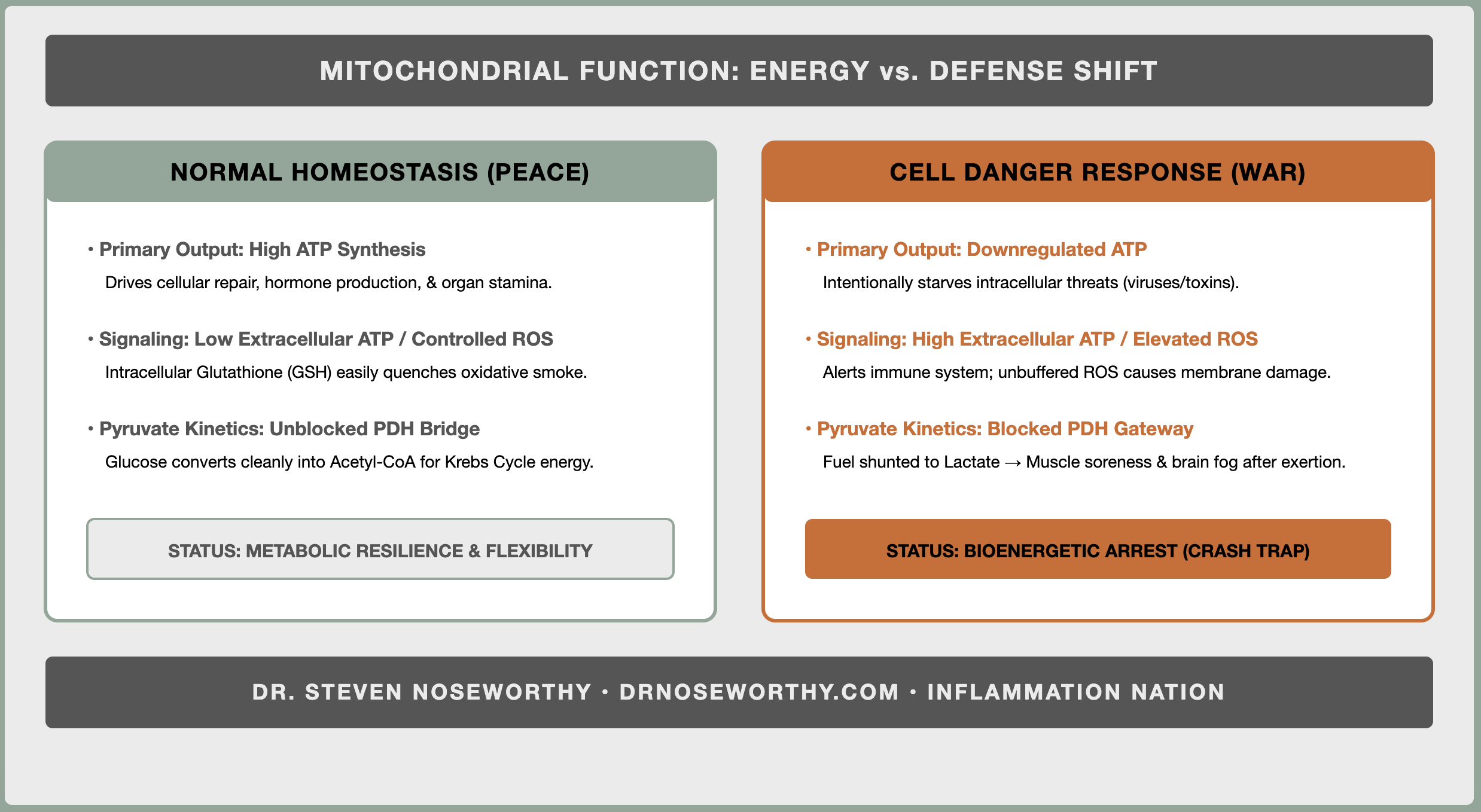
When mitochondria sense persistent danger signals—such as oxidative stress, chronic viral loads (like EBV), heavy metals, or poor tissue oxygenation—they intentionally shift out of energy mode and into self-defense mode .
They downregulate ATP production strategically . Why? Because many intracellular pathogens and viruses hijack host cellular ATP to replicate . By reducing ATP synthesis, the mitochondrion starves the invader . At the same time, it releases extracellular signaling molecules and reactive oxygen species (ROS) to alert the immune system .
If you take mitochondrial supplements (like NAD boosters) or force cold plunges while your cells are locked in CDR, you are attempting to force ATP generation when the cell’s internal intelligence has prioritized biological defense .
Furthermore, forcing mitochondrial respiration when antioxidant pools (specifically glutathione) are depleted generates unbuffered free radicals . This causes further damage to mitochondrial membranes, driving severe post-exertional crashes .
CORE CONCEPT 2: THE PYRUVATE BOTTLENECK & LACTATE ACCUMULATION
This leads directly to the second physiological obstacle in chronic fatigue: how your cells process fuel, and why routine daily tasks create post-exertional muscle soreness and brain fog .
When you consume carbohydrates, your cell breaks glucose down through cytosolic glycolysis into a compound called pyruvate .
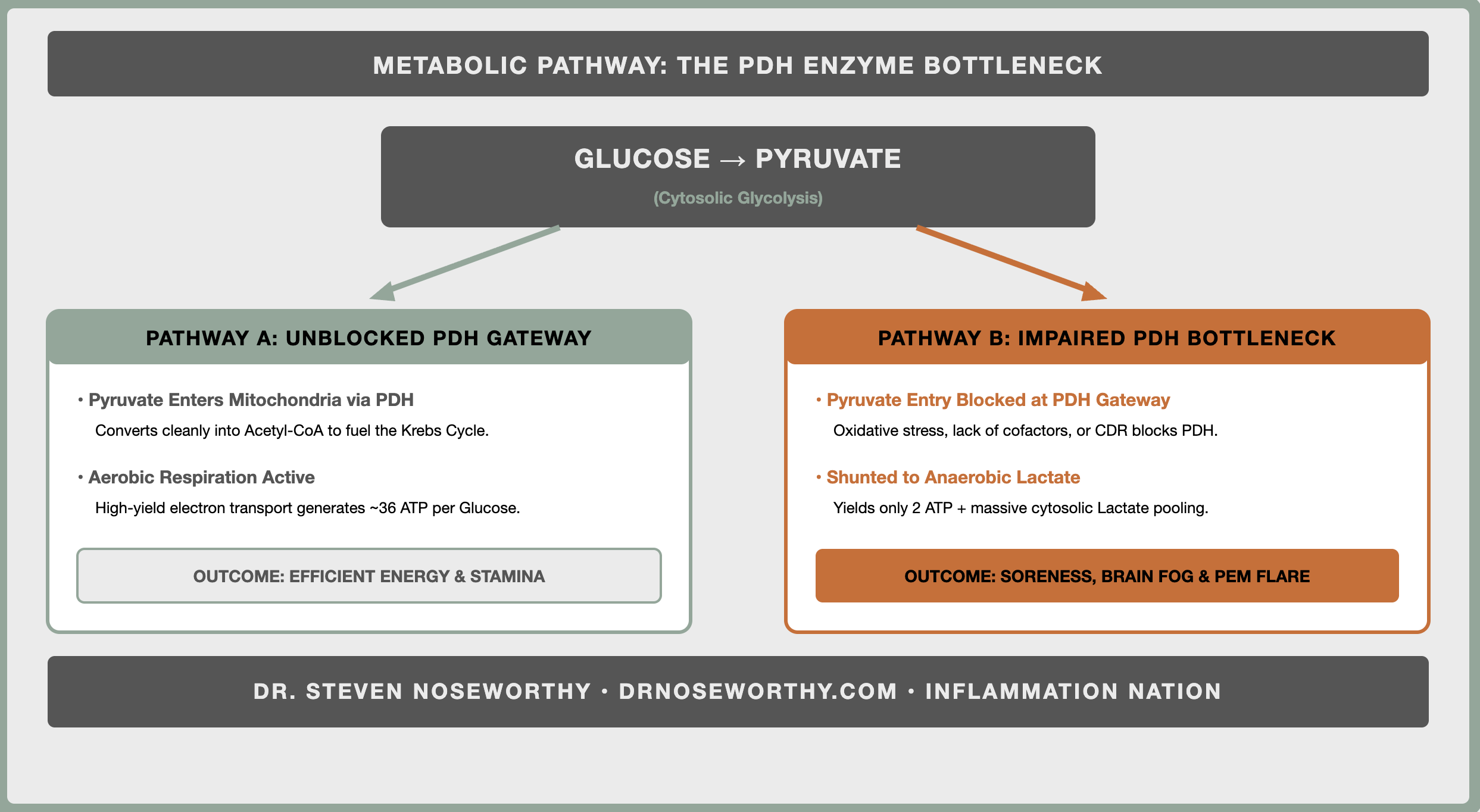
Pyruvate acts as the metabolic bridge between anaerobic glycolysis outside the mitochondria and aerobic respiration inside .
In a healthy system, pyruvate enters the mitochondria through the Pyruvate Dehydrogenase PDH enzyme complex, converting into Acetyl-CoA to drive the Krebs cycle (~36 ATP yield) .
However, the PDH gateway is easily blocked by :
-
B-vitamin deficiencies ($B_1$, $B_3$) or lack of $\alpha$-lipoic acid/magnesium .
-
Heavy metal toxicity (arsenic, mercury) .
-
Metabolic factors like iron-deficiency anemia, B12 anemia, insulin resistance, or systemic inflammation .
When pyruvate entry is blocked, energy production drops by about 1,700% . The cell shunts the accumulating pyruvate into lactate .
This is why chronic fatigue patients feel as if they ran a marathon after simply carrying groceries or walking up stairs . Pyruvate accumulates outside the mitochondria, shifting the cell into high oxidative stress and localized inflammation .
CORE CONCEPT 3: TISSUE PERFUSION, ANEMIA, & GLUTATHIONE
To safely unblock the PDH gateway and exit the Cell Danger Response, you must address two foundational requirements: Tissue Perfusion (Oxygen Delivery) and Antioxidant Buffering .
                [ LUNGS ]
          Breaths in Environmental O2
                   │
                   ▼
         [ RED BLOOD CELLS ]
       Hemoglobin Binds and Carris O2 (Iron-Based Protein)
                   │
                   ▼
        [ MICROVASCULAR FLOW ]
       Delivers Oxygen to cells
                   │
                   ▼
         [ MITOCHONDRIA ]
    Requires O2 for Aerobic ATP Synthesis
1. Oxygen Delivery & Anemia
Aerobic ATP synthesis requires oxygen . Oxygen is carried from your lungs to your cells by hemoglobin, an iron-based protein inside red blood cells .
If you have iron-deficiency anemia (common in women of reproductive age due to heavy cycles), B12/folate anemia, or poor microvascular circulation, your cells experience low tissue perfusion . Without adequate oxygen delivery, mitochondria cannot run electron transport, forcing cells back into anaerobic pyruvate shunting .
2. Glutathione (GSH) Buffering
Mitochondrial ATP synthesis naturally generates reactive oxygen species (ROS) . Intracellular Glutathione acts as the primary buffer, neutralizing ROS before they damage mitochondrial membranes .
When glutathione is depleted by systemic inflammation or poor dietary protein intake (specifically cysteine and glycine availability), ROS accumulate, triggering membrane damage and locking the cell in CDR .
THE HIERARCHY OF BIOENERGETIC RESTORATION
Instead of chasing random mitochondrial biohacks, clinical recovery requires respecting the Hierarchy of Function :
-
Establish Baseline Energy Mechanics: Ensure proper calorie intake—avoiding both chronic caloric overload and prolonged metabolic starvation .
-
Restore Tissue Perfusion & Oxygen Delivery: Evaluate functional blood chemistry (ferritin, iron saturation, red blood cell indices) to ensure adequate oxygen delivery before touching mitochondrial supplements .
-
Quench Intracellular Oxidative Stress: Replenish intracellular glutathione pools and resolve root-cause disruptors (stealth infections like EBV, heavy metals, mold, or gut barrier leaks) so mitochondria no longer sense danger .
-
Unblock the Pyruvate Gateway: Supply key nutrient cofactors (thiamine, niacin, $\alpha$-lipoic acid, magnesium) to reactivate PDH enzyme kinetics, allowing pyruvate to flow cleanly into mitochondrial aerobic pathways .
-
Graded Functional Load: Once cells can safely generate ATP without triggering oxidative damage, reintroduce physical movement tailored strictly within your individual metabolic capacity to avoid post-exertional crashes .
WORK DIRECTLY WITH DR. NOSEWORTHY
Chronic fatigue is not a simple nutrient deficiency or lack of cold plunges . It is a biological state that demands a systematic evaluation of your cellular perfusion, oxidative stress load, and metabolic pathways . You cannot out-hack a cell locked in self-defense mode .
I run my practice on a strict low-volume, high-engagement clinical model . I do not use cookie-cutter templates, and I do not farm your care out to health coaches or uncredentialed staff members .
When you work with me, you deal with me directly, 1-on-1 . Everything from your functional diagnostic plan to your diet, exercise, and targeted nutritional strategy is customized to your physiology .
Ready to stop the biohacking madness and address the actual root cause mechanisms driving your chronic fatigue?
Want to schedule a consult? Are you ready to start taking charge of your health and get this thing figured out? Everything start with a 1-hour consult to see if I can help and to make sure we're a good fit.
Stay connected with news and updates!
Join our mailing list to receive the latest news and updates from our team.
Don't worry, your information will not be shared.
We hate SPAM. We will never sell your information, for any reason.